
This post, and the following two, are taken from the sermon I preached in a local parish on 24 May 2026. I shared with them the coincidence of Wesley Day falling on Pentecost Sunday this year.
The Vicar of Epworth was working late in his study when suddenly he smelled smoke. Someone had set fire to the vicarage. He woke his wife and they rushed to rescue their large family. In all the panic, one of the children was accidentally overlooked. 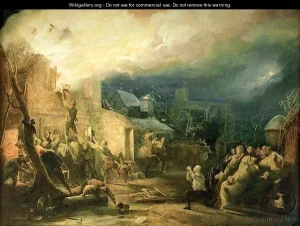 He woke up to find himself blocked off by smoke and flames; all he could do was climb on the bedroom windowsill and call for help. His horrified parents tried to get back inside but the heat drove them back. However one of the neighbours climbed on another man’s back, and the child was snatched to safety just as the roof caved in. With tears of gratitude, the Reverend Samuel Wesley knelt and gave thanks to God for the safety of his eight children and the rescue of five-year-old John. “God has rescued you for a purpose” said Mrs Wesley, reminding him of a verse in Zechariah – you are “like a brand plucked from the burning”. That remark was to mean a lot to John Wesley later in life.
Susannah Wesley was an amazing woman – wife, mother, teacher, and mentor. She taught her large family at home, starting at age five with the alphabet, which was to be memorised in one day. By age ten all her children – boys and girls – were expected to read and write in New Testament Greek. Every week she dedicated a special time to each of her children, giving them one-on-one instruction and encouragement about God, his love and his purpose. Young Jackie, as he was known, would never forget those Thursday sessions with his mother. In myriad conversations, she taught him about Christ’s Great Commission:
Therefore, go and make disciples of all nations, baptizing them in the name of the Father and the Son and the Holy Spirit. Teach these new disciples to obey all the commands I have given you.
(Matthew 28: 19, 20)
Discipleship would become an important priority for Jackie in adult life, as he became the Methodist preacher, the Reverend John Wesley. Literally thousands of people in eighteenth-century England and Wales came to faith in Christ through his ministry.
Today is not only Pentecost, this year it is also Wesley Day, 24 May. On that date in 1738, John Wesley experienced a renewal in his own spiritual life. The experience launched him on a ministry that would transform British society, in an inspiring movement that would span the world.
But I’m jumping ahead.
Some of you may know the story well. Like his father, John Wesley became an Anglican minister with a gift for persuasive preaching. He studied at Oxford University, where he developed a spiritual hunger that drew him and others like George Whitefield to design a systematic format for discipleship, based on the Great Commission. They met to study the Bible and serve the needy, and methodically accounted for their daily activities to ensure no time was wasted. At first, they were labeled the Holy Club – but later their methodical approach to study and service led to the name Methodists being the one that stuck.
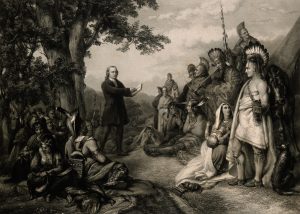 His mother had inspired in John a heart for mission, and in 1735 he traveled to North America to minister to the natives. But he failed dismally. He returned to England knowing that something was missing from his faith. In 1737 he wrote in his diary “I went to America to convert the Indians, but oh! who shall convert me?” Sailing back across the Atlantic, he met a group of Moravian Christians – German Protestants – whose lively faith impressed him deeply. They shared with him about the transforming power of salvation, and advised him to ‘keep preaching’ while seeking his own conversion experience. Back in London, he continued to serve as a clergyman, often struggling with doubt.
One night in 1738 after a time of prayer at St Paul’s Cathedral, he went to a Moravian Bible study in nearby Aldersgate Street. During the meeting – at a quarter to nine – John experienced what is sometimes called his conversion:
“I felt my heart was strangely warmed. I felt I did trust in Christ alone for my salvation.”
He felt assured his sins were forgiven and stood up and testified to the change in his spirit. 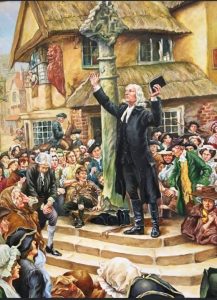 From then on, he began preaching an evangelical message to all who would listen. Just like the disciples whose hearts burned on the Emmaus Road, he had at last grasped the real meaning of the Easter Story.
At the time, in England and Wales, there was a revival. The open-air preacher George Whitefield – yes the same one who had been in the Holy Club at Oxford – was having a huge impact among the rough coal miners of Bristol. He encouraged his old friend Wesley to take leadership of the itinerant ministry. At first. John was not comfortable about preaching outdoors. He once wrote “I held so tenaciously to everything being decently and in order that I would have thought the saving of a soul almost a sin if it had not been done in a church.” (Journal March 3 1749). However, ‘field preaching’ was a very effective method, so he used it. Years later he taught the two-edged policy:
“If an approach ought to work but doesn’t, scuttle it – even if you like it!
If your method is effective, use it to the hilt – even if you don’t like it!!”
From his first outdoor congregation of 3000 in Kingswood, Bristol, he went on to travel thousands of miles and preach 40,000 sermons. Enthusiastic new Christians and spiritually-renewed Anglicans joined his movement. Meeting for Bible and prayer in large gatherings and small cells, they discovered a new meaning and purpose in the faith communities of Methodism. The transformation they experienced was indeed a work of the Holy Spirit, the third Person of the Trinity upon whom he came to rely.
Long my imprisoned spirit lay
Fast bound in sin and nature’s night;
Thine eye diffused a quick’ning ray,
I woke, the dungeon flamed with light;
My chains fell off, my heart was free;
I rose, went forth and followed Thee.
By Charles Wesley, John’s brother.