
This post, and the two with it, are taken from the sermon I preached in a local parish on 24 May 2026. Last time I shared with them the coincidence of Wesley Day falling on Pentecost Sunday this year.
I’ve preached on the subject of Pentecost many times, and a couple of times on John Wesley’s mission journey. But never in the same sermon. So today’s twin themes motif is an experiment. When I realised the two festivals overlap this year, I asked myself, where did Wesley’s experience fit into the church calendar – the centuries-old pattern of the lectionary? 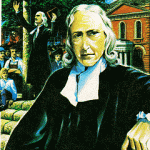 As an Anglican vicar, was John Wesley already thinking of the disciples’ transforming experiences when he had his own strange warming of the heart? I asked Google, where did 24th May fit into the Lectionary in 1738? To my delighted surprise, the answer was that Wesley’s Experience fell three days after Pentecost Sunday, which that year was 21 May. That “new to me” insight confirmed my resolve to take this twin-themed approach today.
So let’s move from Georgian-era London back to ancient Jerusalem by canvassing some Bible background. Luke’s second book – the Acts of the Apostles – sets the scene for us. 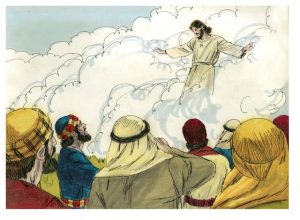 In chapter 1, he tells us right off the block how the risen Jesus ascended to heaven in the presence of his disciples. This was on Ascension Day, 40 days after Easter in the NT timeline, that day when Jesus returned to the heavenly realm to rule and reign, no longer confined to a human body.
I’m sorry that some churches overlook the Ascension becuase it is not a minor add-on; its the explanation of what Jesus is doing right now. When Jesus was physically on Earth, His presence was constrained in a single location. Now, ascended to the right hand of the Father, He is in a position of authority and power. He is interceding for us and he’s responsible for giving us his Holy Spirit, not just once at Pentecost but each and every day.
N T Wright puts it this way: the Ascension was not Jesus’ retirement; it was a change of operations – a functional restructure needed for his disciples to continue living the Jesus Way. Heaven and earth are overlapping and interlocking realms of God’s creation. The enthroned Jesus is no longer limited to one place; not bound by space and time, he manages and orchestrates the ongoing renewal of all things. Think of heaven as not literally up in the sky, but rather the spiritual “control room” or the command centre of the universe, with Earth as the centre of operations. The Spirit is an essential part of that new operational model.
So what happened in Jerusalem in those weeks after Jesus rose from the dead? Over that period, their Master is said to have been teaching them what they needed to know about life and faith – but also that they need to wait for a while, to stay in Jerusalem until they could be filled with the Spirit and become bold witnesses for him. This is what Pentecost is about.
The ancient feast of Pentecost was a harvest festival celebrated by Jews for centuries before Christ. In the time of Jesus, it had been formalised into a set date, 50 days after Passover. By then, Jews had scattered to many different nations, meaning those who returned to Jerusalem for the three main festivals spoke many languages. But they all knew the Hebrew Scriptures, and the symbolism of wind and fire in their cultural history. Here’s a quick summary:
- Moses encountered God in a burning bush as he stood on Holy Ground near Mt Sinai
- Later on the same mountain, he was engulfed by thick smoke, thunder and fire as God entrusted to him the ten commandments.
- Moses was instructed to build a tabernacle, a mobile worship centre where God dwelt, appearing as they travelled in a cloud by day and fire by night.
- When the Hebrews settled in Jerusalem, they built a permanent Temple, where sacrifices were offered at the fire on the outdoor Altar and incense was burned indoors.
- The disciples and the Jewish pilgrims visiting Jerusalem would all have known this as they experienced the wind and fire of the Holy Spirit.
When I was growing up in the fifties, we thought of the Holy Spirit as a force, an energy, what one writer called an oblong blur. Acknowledged once a year, when we sang about impersonal metaphors like wind and doves. But in my late teens I was part of the Charismatic Renewal at St Paul’s in Symonds Street, and I learned about the spirit in a new way and with a new assurance. These days we know that the Spirit is not an oblong blur, but a person, fully equal with God the Father and God the Son. Luke and the other NT writers make it clear that the Holy Spirit behaves as a person. He speaks, he teaches, he grieves, he makes decisions, he persuades, he intercedes. An impersonal blur or force does not do that. These are the actions of a person with intelligence, will and emotion. What Christ did in earthly human lives is now the work of the Spirit – conviction, salvation, new life, holiness and assurance. Fruit and Gifts. Presence and Power. The Spirit is not an optional add-on; he is God’s personal presence in our lives.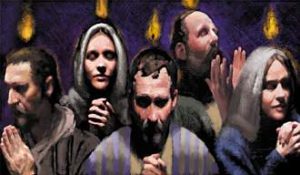
The dramatic story in Acts 2 tells us that their weeks of fear are replaced by a fresh trust and assurance. Those who are are baptised receive a new boldness, a shared culture and an inclusive compassion for others of all nationalities. They proclaim the Jesus way of love and hope, where no one is left behind. This new world is not to be divided by enmity and marginalism; the people of the Spirit will be sent out by their king to love unconditionally.
Wind and fire and tongues, these were prophesied hundreds of years before. This miracle is a demonstration of God’s power and his longing for people to be a caring community. It shows that being a temple of the Spirit is no longer a geographical or architectural space; it’s a sanctuary made out of each one of us, a tangible sign of God’s love through our presence in the community. The new temple is an overlap of heaven and earth, not on a mountain or in a cathedral, but made up of the daily lives of thousands of men and women who, like John Wesley, follow and serve Jesus.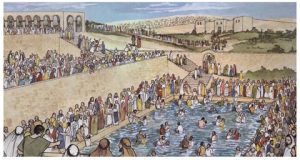
Love divine, all loves excelling,
joy of heav’n, to earth come down,
fix in us thy humble dwelling,
all thy faithful mercies crown.
Jesus, thou art all compassion,
pure, unbounded love thou art.
Visit us with thy salvation;
enter ev’ry trembling heart.
Come, Almighty, to deliver,
let us all thy life receive.
Suddenly return, and never,
nevermore thy temples leave.
Thee we would be always blessing,
serve thee as thy hosts above,
pray, and praise thee without ceasing,
glory in thy perfect love.
By Charles Wesley, John’s brother.