
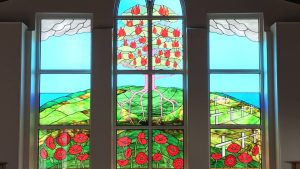
 When I was a child in the fifties, Anzac Day was a big deal. I was part of a uniformed youth movement and so we turned up in full uniform at the 10am Civic Service in Titahi Bay, to join the parade, marching and saluting and praying, and singing O God our Help and God Save the Queen. We learned about the ill-fated landing at Gallipoli at school every year and understood it was part of our national identity and pride. (Read More about Anzac Day on Wikipedia)
I knew my Dad was in the War but he had told us little about his five years in Europe. As I got older, I began to be suspicious of Anzac Day. The marching veterans seemed to be mostly drunk. The current servicemen and women seemed at times to glorify armed combat. My Dad started wearing the uniform of a Lieutenant Colonel, even though I knew he was only a Private. In the sixties., when I stopped standing for the Queen at the movies, I also decided I was a Pacifist. I started having discussions with Dad about war and peace. I recall one long conversation when I challenged him about why he had signed up in 1919, when he was not only a Christian but studying to become a minister. In fact, he had lied about his age so he could sign up and not be conscripted; he felt it needed to be his own moral choice to join the Army. He explained to me that what was happening in Europe at that time was so explicitly evil, he needed to stand against it.
When I was 19 myself, I saw the film Rise and Fall of the Third Reich. I started to glimpse what Dad was talking about. We had many more conversations about War and Justice. I discovered that he was the Chairman of the Government Committee overseeing thirty Chaplains to the Forces, with the rank of Lieutenant Colonel to mark this senior position. He had always been a member of the RSA, and acted as padre for them in several places we lived. Mum was ten years younger, so had a different war experience. But she deeply respected the men and women who had served, and every Anzac Day Mum and Dad would attend the Dawn Service or in the later years the daytime one, wherever they lived. By the time Dad passed away, that was Taupo and even after his death Mum still attended Anzac services there till she too was gone.
In his eighties Dad wrote a memoir which I edited for him. It didn’t tell of the war’s worst horrors, but it did provide many details of his four and half years as a POW in Austria, when deprivation and cruelty left him with a number of health problems. His farm upbringing must have endowed him with resilience though, as he lived to be 92.
On April 25 2026, my siblings and I gathered at Onetangi Beach (Waiheke Island) to honour our late parents. We endeavour to do this every Anzac season. Since we all live in a different part of the country, not everyone gets there every time, though attention is given to them wherever we are. We have often met in Taupo, gathering in a motel just over the road from their old house in Rifle Range Road, Taupo. Last year, we ate melting moments and raspberry slice and visited their little plaque in Taupo Cemetery. The speaker at the Dawn Service that day paid tribute to those who had “stepped up” in various theatres of war, and we gave thanks for Bill and Tui McLeay who both “stepped up” in myriad ways in that community and many others. As we departed, I noticed a small sign adorned by two poppies, hung on the fence of the old house at number 48 Rifle Range Road. It read We will remember them.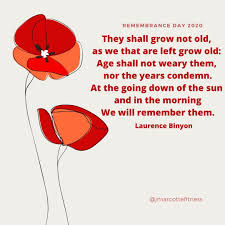
This year we all made it to the alternative venue on Waiheke, though one sister had to leave on the Saturday morning, so she and I went to the Island two days earlier and had a great old catchup. The usual pattern for Anzac Day on Waiheke is for a Dawn Service held at around 6am, starting in the dark, and experiencing the dawn as a mark of hope. A second Civic Service is held mid-morning, for those with families and the elderly.
The liturgies these days are a blend of traditional and modern cultures, with greetings in Te Reo, and speeches from currently serving service men and women. This year the debate was, which service shall we go to? We are all getting older and less mobile, and Sis had to leave before the second one. However, we are a capable lot and decided that instead of having to navigate the RSA’s closed road and shortage of car parks, we would have a DIY service on the beach in front of our apartment. Two of us are ministers, so we had resources, and we followed the traditional “hymn sandwich” pattern, using our phones for the music. Each sibling contributed something special – a prayer, a picture, a Scottish lament.
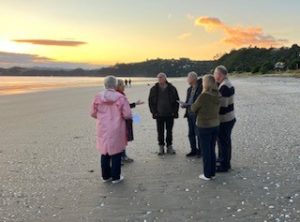 Out on the sand, it was low tide, silent and still, no dog walkers or boat launchings. After the National Anthem and some Scripture and prayer, my brother read an excerpt from Dad’s wartime memoir, and we shared memories, somewhat tearfully. Then, more conventionally, we read the Ode, a verse from Laurence Binyon’s 1914 poem “For the Fallen”. Then we listened to the Last Post, the mournful bugle call that signifies the end of soldiers’ daily activities. A Minute’s Silence – and then came the Reveille, one of the bugle calls that marks the break of day. To us as Christians, this has the deeper significance of faith and hope. We sang all the verses of O God our Help in ages past, and shared the Blessing with one another.
Back at the apartment, we ate breakfast around the big table, and later shared meals at local restaurants. On Sunday, some of us went to church , while others were taken to meet their various ferries. The weekend also included a family quiz I had prepared, with trivia questions about each of us and both of our parents. Non-competitive and lots of fun!
We shall remember them.